Virtual Church: A Complete Guide to Worshipping Online
16 November 2026 · Grace Cathedral
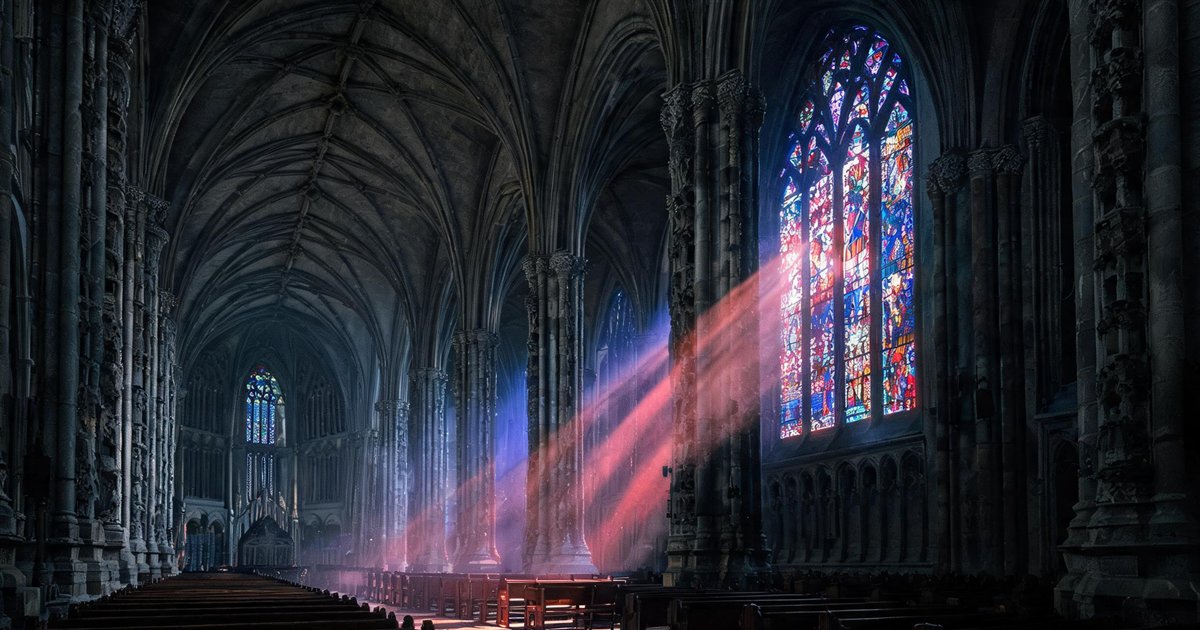
The phrase does two jobs at once, and it is worth separating them before anything else. A virtual church can mean a website that streams a service, or it can mean a building — modelled in three dimensions, opened in a browser, walkable — that exists for no other purpose than prayer. This guide is mostly about the second, because it is newer and raises the harder questions. But the first is where most people begin, and it deserves a fair account too.
What a virtual church is and is not
In the strict sense used here, a virtual church is a persistent three-dimensional sacred space that you enter and move through rather than read. It has a floor plan, a door, a nave, an altar, side chapels, and a candle stand. You arrive somewhere, and leaving takes an action. The graphics may be simple or elaborate; what matters is the geometry, because geometry is what makes a room behave like a room rather than like a page.
The term is used loosely for at least four different things: a livestreamed liturgy, a prayer app with daily texts, a 3D model you can walk through, and a headset gathering of avatars around a shared screen. They have a screen in common and almost nothing else. A livestream is an event you watch, an app is a text you read, a 3D church is a place you visit, and a VR gathering is a meeting you attend. Most bad arguments about the subject come from sliding between those four without noticing. The narrower definition is treated in the guide to what a virtual church actually is.
What it is not is easier to state and more important to keep. It is not a sacrament, not a parish, and not the assembly of the faithful. The Church has said so plainly, most directly in the Pontifical Council for Social Communications' 2002 reflection The Church and Internet, which welcomes the new media while insisting that virtual reality cannot substitute for the sacramental and communal life of the Church. That is not technophobia. It is the logic of the Incarnation: God chose matter, and the Church has never agreed to pretend otherwise.
There is a useful distinction underneath. The Church is a people before she is a building — Lumen Gentium begins with the Church as a mystery of communion, not with architecture — so a nave made of polygons is plainly not "the Church". But Christians have always built rooms that carry prayer: chantry chapels, roadside shrines, the small Lady altar kept open when the main doors are locked. This kind of place belongs with those. It is a devotional help, not a sacrament, and once that line is drawn most practical questions answer themselves.
Virtual church vs. a livestreamed Mass
A livestream is an event at a fixed hour. A camera stands in a real church; a real priest stands at a real altar; a real congregation is present, even if the building is half empty. What reaches you is genuine sound and genuine images of a genuine liturgy. What does not reach you is the sacrament. The Mass is happening; you are watching it happen, which is a different thing from receiving it.
A 3D chapel runs on the opposite logic. There is no schedule, no celebrant, no congregation, and no liturgy. You choose where to stand and how long to stay. Nobody performs anything for you, which is why the room can be quiet. If a livestream is centrifugal, pulling you toward an event, a 3D chapel is centripetal, pulling you inward toward a single intention. They are not competitors; they do different work on different days.
That suggests a division of labour. On Sunday, go to a parish if you can; if you cannot, watch a livestream and read the readings in advance so that you are praying rather than channel-surfing. On a Wednesday night, when there is no Mass to watch and no one to greet you, the chapel is the better room. Many Catholics also pray an act of spiritual communion during a broadcast — an old devotion, recommended by saints and popes, in which the desire for the Eucharist is offered to God. It is honest and traditional, and still not the Eucharist.
A simple rule holds: use the livestream when the Church is doing something, and the chapel when you are.
Who a virtual church actually serves
The first group is obvious. People who are ill, housebound, disabled, recovering from surgery, or caring for someone who cannot be left alone. For them a walkable chapel is not a novelty; it may be the only room of that shape they can reach this week. The second group is the displaced: students in another country, workers on night shifts, families far from a parish, travellers who have lost their Sunday bearings.
The third group is the bereaved. Grief keeps strange hours and does not consult the parish office. A person who needs to light something at two in the morning cannot wait for the doors to open, and does not want to explain themselves to a sacristan. The fourth group is the curious: people who have never been inside a Catholic church and would like to know what one feels like before walking into a real one. That is a respectable way to begin.
There are people the format serves badly, and it is worth naming them. Anyone using a virtual church to avoid the parish indefinitely is avoiding something rather than praying. Anyone who needs confession, anointing, or the Eucharist is in the wrong room, however beautiful it is. And anyone looking for a screen that will tell them what God thinks of them should be warned: no honest site will do it. It is a doorway, and a doorway is not a destination.
What you can do inside a 3D church
You can walk, which matters more than it sounds. In a real church the distance from door to altar is a small pilgrimage; the side chapels are not equally convenient, and choosing one costs something. A 3D nave preserves that arithmetic. Walking to the far chapel takes longer than walking to the near one, and the extra ten seconds are the difference between clicking a link and going somewhere.
You can look. Most 3D churches are modest in detail, but a side altar with a statue, a rack of candles, and light behind a window will hold attention longer than a paragraph about the same things. Grace Cathedral is laid out with fourteen side chapels off the nave, each with its own altar and its own saint. The variety is the point: you are not choosing a mood, you are choosing whose company to keep.
You can act. Light a candle. Write a name. Sit in a pew, stand at the back, kneel if the space allows it. None of these gestures produces grace by itself, but they are how a body agrees with a prayer. The Church has always understood this — it is why she blesses candles, incenses altars, and asks people to fast with their stomachs and not only with their intentions.
And you can listen. Sound is half of architecture: an organ loud enough to stop conversation, footsteps on stone, the low room tone of a large empty building. Turn the sound on for one visit, then off, and notice what changes. If you want a name to remain somewhere, the memorial wall keeps the candles visitors have chosen to make public, and you can walk the nave yourself at any hour without being asked who you are.
The limits: sacraments, community, and the body
The sacraments are the hard boundary, and they are not negotiable. Baptism needs water and a body. Confession needs a priest who can hear you in person. The Eucharist needs bread, wine, and an ordained minister; a consecrated host cannot be transmitted. Anointing needs oil and hands. Marriage normally needs a priest and two witnesses. Ordination needs a bishop. Every one requires matter, and a screen has no matter to offer.
Community is the quieter limit. A virtual church has no one to cook for, no roof fund to argue about, no parishioner who will notice you have been absent for three weeks. That absence of friction is also an absence of the particular grace friction carries. The communion of saints is not a contact list, and the Church is not sustained by people who never have to forgive one another. If a virtual church is your only church, something has gone slightly wrong, even if nothing dramatic has.
The body is the third limit. You cannot smell beeswax, feel cold stone through a coat, or shake a stranger's hand at the sign of peace. Screens tire the eyes and flatten depth. None of this is fatal, but it is real, and pretending otherwise makes the practice less credible. The body is not an accessory to prayer; it is the medium of it. A screen can remind you of that. It cannot replace it.
One legal point deserves plain speech, because websites sometimes blur it. Watching a Mass on a screen does not fulfil the Sunday obligation, and no site should imply that it does. If illness, distance, or caregiving prevents you from attending, the obligation does not bind you, and you are not required to substitute anything. You are simply free to pray. That freedom is worth more than a false reassurance.
How to choose a virtual church
The internet has no shortage of things called chapels, and a few tests sort them quickly. The first is honesty: the site should say plainly that it is not a sacrament and not a parish, without hedging. The second is silence: if the page is built to be scrolled, if speech autoplays, if advertisements sit beside the altar, it is a magazine with a cross on it. The third is access: a chapel that demands an account or an app install before it will let you sit down has misunderstood the transaction.
Beyond those, look for the marks of a place rather than a product. Good signs include a fixed way to leave, an option to turn sound off, names that stay private unless you choose otherwise, and a link to help you find a real parish nearby. Warning signs include guaranteed answers to prayer, tiers of candles at different prices, an AI figure pretending to give absolution, and any suggestion that payment improves the spiritual outcome. Where a site forgets that the Gospel is not for sale, close the tab.
Accessibility is part of quality, not a footnote. Keyboard navigation, reduced-motion settings, captioning, and modest bandwidth requirements are the digital equivalent of a ramp at the door. A sacred space that excludes people with disabilities has failed at the first thing a church is for. Test a site the way you test a building: can you get in, find a seat, and leave without help?
Finally, ask what the visit does to you. If you close the tab hurried, sold to, or vaguely watched, the space is not doing its job. If you close it a little more patient with the person in the next room, it probably is. A virtual church is judged by the ordinary life it sends you back to. For a narrower, more contemplative version of the same room, the guide to an online chapel takes the question from that direction.
A short history of churches on screens
Christians have been putting worship through media for longer than most people assume. Vatican Radio was founded in 1931, and papal broadcasts were being heard across continents within a decade. Televised Masses became familiar in the 1950s, and the Church answered with documents rather than alarm: Pius XII's 1957 encyclical on motion pictures, radio, and television, and the Second Vatican Council's 1963 decree on social communications, which asked Catholics to use the media well rather than merely to distrust them.
The pattern has repeated with each technology. The Pontifical Council for Social Communications' 1971 pastoral instruction Communio et Progressio described the media as a new culture rather than a set of tools, and by the 1990s parishes had websites and email prayer chains. In 2002 the same council issued two documents, Ethics in Internet and The Church and Internet, which set the terms still used today: the internet is a genuine good, virtual reality is not the same as presence, and the sacraments cannot be moved online.
Then came 2020. When churches closed, livestreams became the default and priests learned to celebrate Mass for a camera. It was a real response to a real emergency, and it kept many people praying. It also produced a correction. Once buildings reopened, most congregations discovered that the stream had been a bridge rather than a home, and attention moved back to the physical assembly — while a smaller, steadier audience remained for quiet spaces that had nothing to do with Sunday.
Three-dimensional churches belong to that third wave. They are not broadcast and not social media; they are closer to architecture than to television. The technology is young and uneven, and the best examples are deliberately modest. But the question they raise is old, and the Church has already answered it: a screen can carry prayer, and it cannot carry a sacrament. Everything else in this guide follows from that sentence.
Questions people ask
Is it a real church?
No, not in the sense the word has in Catholic teaching. It is a devotional space, not a parish and not a sacrament. The Church is a people gathered in faith, and her sacraments require bodies, matter, and the ministry of an ordained priest. A 3D chapel can be a real place of prayer; it cannot be a church in the theological sense.
Does watching fulfil the Sunday obligation?
No. The Sunday precept is to participate in the Mass, and watching a screen is not participation in the sacrament. If illness, distance, or another serious reason prevents you from attending, the obligation does not bind, and you are not asked to pretend it has been met. Watch a livestream by all means, but call it what it is.
Can I receive Communion here?
No. The Eucharist requires the ordained minister, bread and wine, and the physical presence of those who receive. Nothing on a screen can be consecrated or consumed. An old devotion called spiritual communion can be prayed during a livestream, but it is an act of desire, not the sacrament.
Is it only for Catholics?
No. Many visitors are curious, grieving, or simply looking for a quiet room, and none of them need to explain themselves. Nothing in a 3D chapel is reserved to members, and no one is watching who enters. If you are not a Catholic and want to understand what you are looking at, it is a reasonable place to begin.
Do I need an account or a headset to use one?
You should not. A well-built chapel opens in an ordinary browser and asks for nothing. Headsets are optional everywhere. A chapel that requires registration before it will let you sit down has misunderstood what it is offering, and you are free to close the tab.
So what is it, finally? It is a room made of code, kept open for people who need a room and cannot reach one. It will not replace your parish, and it should not try. It is at its best on an ordinary Tuesday, when nobody is watching and someone is grieving, and a door opens anyway. The guides on praying a novena, on keeping All Saints' Day, and on finding a quiet online chapel will each take you a little further in.
Fourteen side chapels, a candle rack, and an organ. The door is open.
Walk into the chapelGrace Cathedral · All guides · Memorial candles · Home