All Souls' Day: Lighting a Candle for the Dead
16 November 2026 · Grace Cathedral
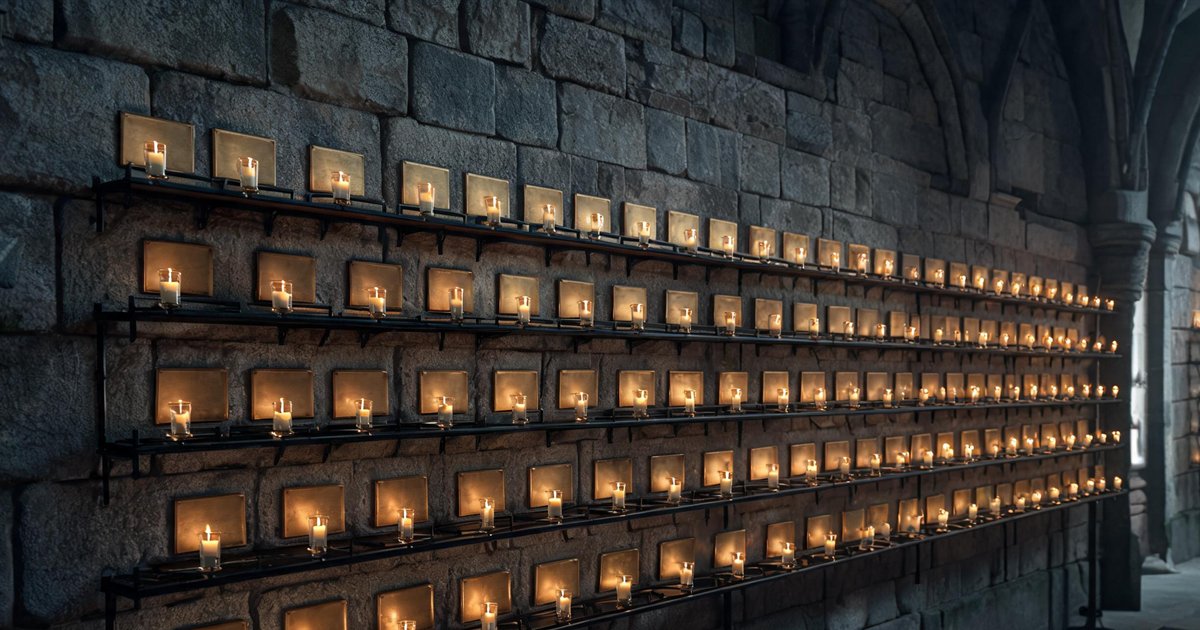
The second of November is the quietest great feast in the Catholic year. There is no white vestment, no triumphant hymn, no obligation to attend. And yet an all souls day candle is lit in more countries than almost any other devotional gesture in the Church — in cemeteries in Poland and the Philippines, on window sills in Ireland, in small red glasses on the racks of parish churches. A flame is what people do when they have nothing else to give, and the Church has always accepted it.
What All Souls' Day Commemorates
All Souls' Day, formally the Commemoration of All the Faithful Departed, is kept on 2 November: the day after All Saints. Where All Saints' Day honours those who have reached heaven, All Souls' Day prays for those who died in God's friendship but are not yet fully purified — the souls in purgatory. The doctrine is not a map of the afterlife. It is a statement that love does not stop at death, and that a person who is still being healed can still be helped by our prayer.
It follows, then, that the day is not primarily about grief. It is about usefulness. You cannot do anything for someone who has died except the one thing the Church has always said matters: pray. And you may, on this day, gain a plenary indulgence for the dead under the usual conditions — confession, Communion, prayer for the Pope's intentions, and a visit to a church or cemetery in the first days of November.
Why an All Souls' Day Candle?
A candle answers three problems at once. It is a sign of presence, because a flame has to be tended and someone has to be there. It is a sign of hope, because light is what the Church uses for Christ. And it is a sign that survives silence: you can light an all souls day candle when you cannot think of a single sentence to say, and the gesture still says it.
The custom is older than any of the devotional books. In much of Europe families went to the graves on the evening of November 1 or the morning of November 2 with candles and lamps, and the cemetery became, for a few hours, the brightest place in town. In Poland the candles are called znicze and the graves are covered with them. In the Philippines families keep vigil and light candles through the night. In Mexico the first two days of November are kept with ofrendas, marigolds and light, in a distinct tradition that the Church has long treated with respect.
None of this is superstition, provided you understand what a candle is not. It is not a payment, and it does not shorten anyone's purification by itself. It is a prayer made visible, and a way of keeping watch.
How to Light an All Souls' Day Candle
- Name one person. Not "all my dead." Say the name. Say it out loud if you are alone.
- Light the flame and stay with it a moment. Ten seconds is enough; a minute is better. The staying is the prayer.
- Ask for what the Church asks for. Not that they be remembered — God has not forgotten them — but that they be brought to the joy of the saints.
- Say the old prayer. "Eternal rest grant unto them, O Lord, and let perpetual light shine upon them. May they rest in peace. Amen."
- Leave the candle burning safely, or note the place where it stands, so that tomorrow you remember to pray again.
If you are praying for several people, light several candles rather than one. A single flame carrying eight names is how we treat things we want to be done with.
Keeping the Whole Month
The Church sets aside the entire month of November for prayer for the dead; All Souls' Day is its hinge rather than its end. Many parishes keep a Book of the Dead near the sanctuary through November, where anyone can write a name. Some families pray the Rosary at home on the second and again on the anniversary of a death. Grief has a calendar, and the calendar can be given to God.
Praying When You Cannot Get to a Grave
Most people cannot stand in the cemetery they grew up beside. Work, distance and the last few years have made that ordinary. You can still keep the day. Open the cathedral, walk to the candle rack by a side chapel and light a flame there; the Church is one building, and a nave in a browser is still a nave. If you want a longer prayer than a single candle allows, the guide to praying for the dead online gives a simple method, and the piece on virtual memorial candles explains the small etiquette of keeping a flame for someone over months rather than minutes.
One last word on timing: the observance begins on the evening of November 1, and in many places the whole of the first week of November carries the same indulgence. You have not missed it if you arrive late.
An all souls day candle is a small thing, and it is meant to be. It says that the dead are not a closed subject, that prayer crosses a boundary we cannot see, and that the person you are still missing has not stopped being part of the Church. Light one on the second of November. Say the name. Leave the flame where you can see it.
Related guides
- A guide to lighting a candle online
- Praying for the dead at any hour of the night
- Choosing a virtual memorial candle that lasts
Light a flame for someone you have not stopped missing.
Walk into the chapelGrace Cathedral · All guides · Memorial candles