Light a Candle Online: What It Means and How to Do It Well
16 November 2026 · Grace Cathedral
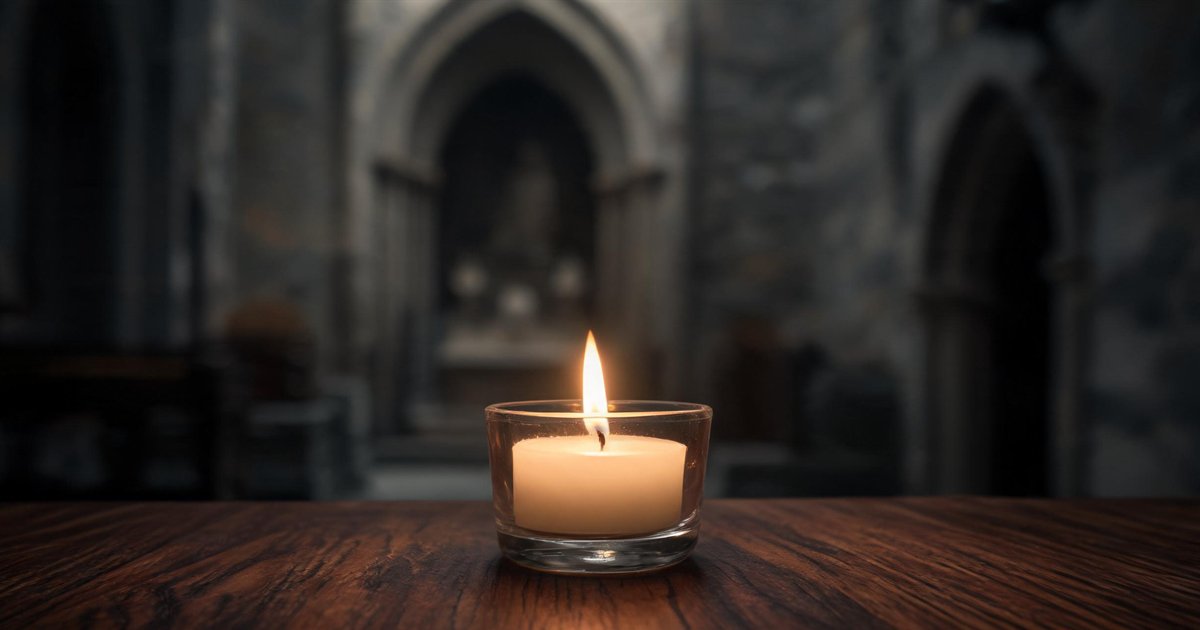
A candle is one of the few things in a church that still works exactly as it did in the first century. Wax, wick, flame, and a person standing in front of it with something to say. To light a candle online is to carry that gesture into a medium that has no wax — and the gesture survives better than you might expect, provided you know what you are doing and what you are not.
What a votive candle actually is
The word comes from the Latin votum, a vow or a wish. A votive candle is a small candle, usually in a coloured glass, set on a metal stand near a side altar or a statue and lit as an accompaniment to prayer. It is not a large candle and it is not meant to be. Its smallness is part of the point: it burns for a limited time, and the limit is a reminder that the prayer, not the object, is what lasts.
The rack is a deliberately anonymous place. Some flames are new, some are nearly out, and nobody knows who lit which one. You can stand there for four minutes and cry, and no one will ask you anything. That anonymity is one of the mercies of Catholic devotion, and it is why the practice has survived every attempt to make religion more efficient.
It helps to know what a votive candle is not. The red lamp hanging near the sanctuary is not a votive candle; it marks the reserved Blessed Sacrament, and it is a sign of presence rather than an offering. Altar candles belong to the liturgy and are lit for Mass. The paschal candle is a single great candle of the Easter season, from which the baptismal candle is lit. The small glass on the rack is a different thing entirely: private, repeatable, and available at any hour.
One technical note. A candle blessed by a priest is a sacramental, not a sacrament. Sacramentals dispose us to receive grace and accompany prayer, but they do not confer grace the way baptism or the Eucharist does. That distinction keeps an online candle in its proper place: a real help, and not a machine.
Why Catholics light candles
The practice is older than any of its current forms. The early Christians buried their dead by lamplight and kept lamps burning at the graves of the martyrs; the catacombs are full of small oil lamps, and the custom of light at a tomb has never really stopped. When churches were built over those graves, the lamps came inside with them. A candle at a shrine is a remnant of that older vigil.
The Easter Vigil gives the practice its centre. A fire is blessed outside the church, the paschal candle is lit, and the deacon sings the Exsultet, which calls the candle a pillar of fire and a light that no darkness can overcome. From that flame the baptismal candles of the whole year are lit, and at the other end of life the same kind of light is placed beside the coffin. Birth, death, and the long middle are marked with the same small fire.
There is also a feast for candles. On 2 February, the Presentation of the Lord, parishes bless the candles that will be used through the year, and the day is still called Candlemas in many places. The blessing is not a spell; it is a prayer that these ordinary objects will serve a holy use, the way a blessing asks God to make ordinary things carry more than they can alone.
Underneath all of it is a simple theology of signs. Christ calls himself the light of the world; the flame is a sign of him, of the prayer rising with its smoke, and of the watcher who stays awake. What the candle adds is not power but company — it gives the body something to do while the soul is trying to speak, and it makes the prayer visible enough that you remember having made it.
Lighting a candle for someone who has died
The candle beside the dead is one of the oldest instincts in Catholic culture. A wake keeps a light near the coffin; a funeral begins with a flame; November opens with candles on graves. In Poland and Italy, in Mexico and the Philippines, families light lamps at the cemetery on the anniversaries and on the feast of All Souls. The details differ and the instinct does not: we do not want the name to be in the dark.
When you light a candle online for someone who has died, do the three things the ritual expects of you. Say the name, in full, with the dates if you know them. Add one sentence, not a eulogy — "We still miss you", "Your grandson was born on Tuesday", "I am sorry about the last year". Then pray the old prayer slowly: "Eternal rest grant unto them, O Lord, and let perpetual light shine upon them." The words are short because grief does not need a lecture.
Keep the theology straight, because it protects you. You are not sending the flame to the dead, and you are not communicating with them. You are asking God to be merciful to them, and the candle is the sign of that asking. The Church forbids necromancy and every attempt to consult the dead — not to make grief harder, but to keep it honest. Prayer for the dead is an act of hope addressed to God, not a séance with a screen.
If you want the gesture to last longer than a single visit, a memorial candle that burns for thirty days is the usual form, and there is a separate guide to the virtual memorial candle that explains the etiquette around it. If you are keeping the whole of November, the piece on All Souls' Day sets out the month's customs, and the memorial wall gathers the names visitors have chosen to make public.
The difference between a candle and a donation
Candles cost money. Wax, glass, wicks, and the electricity or gas that keeps a rack lit all have to be paid for, which is why a coin box has stood beside the rack for centuries. That box is not a price list. It is a place to leave an offering toward the upkeep of the church and the cost of the wax, and the offering is not what makes the prayer work. If you have nothing to put in it, you are still allowed to light a candle.
A donation is a different act with a different name. Almsgiving — giving to the poor, to a parish, to a hospital chaplaincy — is one of the classic works of mercy, and the Church treats it as worship when it is done freely. It is not a fee for a spiritual product. The moment a site suggests that a larger gift produces a better result, it has confused two things that the Gospel keeps separate.
The Mass intention is a third thing, often confused with both. When you ask a parish to offer a Mass for someone, a small offering is customary and goes to the support of the priest. Church law deliberately limits how many offerings a priest may accept for a single Mass, precisely to keep the practice from turning into a market in grace. The Mass is not bought; the offering is a share in the Church's support of those who celebrate it.
Here is a plain test for any website. Would you give the same amount if no candle appeared on the screen? If yes, you are making an offering. If no, you may be buying reassurance, and reassurance is the one thing a candle cannot supply. Close the payment page and pray anyway; the prayer will be just as real and the flame was never the point.
How to light a candle online without superstition
Superstition is not the same as symbolism. A sign points beyond itself; a charm is treated as a cause. The Church warns against superstition because it attributes to a creature what belongs to God, and it defends the good use of sacramentals in the same breath. A candle can be either, depending on what you think it is doing — so if you are about to light a candle online, test your expectation first.
Ask what you believe the candle is doing. If you believe that three candles will be heard faster than one, that a red glass attracts a particular kind of grace, or that a flame going out is an omen, you have moved from sign to cause. None of that is Catholic teaching, and none of it is harmless: it turns prayer into technique and disappointment into a verdict on your faith. God is not a mechanism, and the number of candles is not a currency.
Watch your language, too, because language shapes belief. Words like "energy", "manifest", "guaranteed", and "spell" belong to a different universe of discourse, and a site that uses them is not offering Catholic devotion with a modern skin. Words like "remember", "ask", "accompany", and "watch with" belong to this one. If the copy around the candle sounds like a marketplace, the candle is probably a product.
The online medium adds its own temptations. Endless racks, premium flames, counters that congratulate you, messages assuring you that your prayer "has been received". Some of these are harmless interface design; others are quietly teaching you that prayer is a transaction with a receipt. The honest way to light a candle online is simpler: one candle, one name, one prayer, and a flame that goes out on its own schedule. Its finitude is not a bug. It is the same lesson a real candle teaches.
Candles in the liturgy and outside it
Candles inside the liturgy are not decorations and not private offerings. They have assigned roles: the altar candles that accompany the celebration of Mass, the paschal candle that stands in the sanctuary through Easter, the candle given at baptism, the lamp that marks the reserved Sacrament, the four candles of the Advent wreath. Their number, placement, and timing are governed by liturgical law, because the liturgy is the public worship of the Church and not a stage for individual taste.
The Second Vatican Council's Constitution on the Sacred Liturgy drew a careful line between the liturgy itself and popular devotions, asking that devotions be harmonized with the liturgical seasons rather than competing with them. A votive candle belongs on the devotional side of that line. It has no rubric, no required number, and no fixed place in the rite. It is a private or communal act of piety, and it is free to be simple.
The distinction is not fussiness. It protects both halves. If devotion pretends to be liturgy, people begin to think that a candle is a sacrament and that a screen can supply what only the Church can give. If liturgy is reduced to private devotion, the public worship of the Church becomes a matter of personal preference. Keeping the two in their places lets each be honest.
At home, the same logic applies without any rubrics at all. A candle on a kitchen table, lit while you pray, is a domestic devotion of the oldest kind. You may have it blessed if you wish; you may simply light it. What you should not do is treat it as a substitute for the Mass, or as a device for getting something. It is a small light in a room, and that is enough.
A short checklist before you click
Nine questions will keep the gesture honest, whether you are about to light a candle online for the first time or the thirtieth.
- Can you name the intention in one sentence? If it takes a paragraph, choose the person rather than the problem.
- Is it one candle for one person? A crowd of names on a single flame muddles the act; light several small ones instead.
- Will the name be public? Check the default. A grief should not be published by accident, and a memorial should not become an announcement.
- Is there a price, and what is it for? An optional gift toward wax and upkeep is reasonable. A fee for a better outcome is not.
- Does the site promise results? Healing, a job, a reconciliation, a sign. No honest chapel guarantees any of them.
- Is the sound under your control? If you cannot turn it off, you are on a page rather than in a chapel.
- Will you stay for thirty seconds? Decide before you click. The staying is the prayer; the click is only the door.
- Do you know how to leave? A good sacred space lets you go without a farewell interview or a newsletter prompt.
- Could you do this in a real church this week? If yes, do both. The screen is a bridge, and bridges are for crossing.
None of this is meant to make you nervous; the gesture is small. The checklist exists because the internet is very good at turning a moment of devotion into a transaction, and because grief deserves better than a checkout flow. If a site passes all nine, it has earned your four minutes.
Questions people ask
Is a candle on a screen a real candle?
It is a real prayer and a sign, not a real flame. Nothing is burning, and no wax is being consumed. What makes any candle a Christian act is the prayer it accompanies, and that prayer is just as real in front of a screen. The flame is the sign that carries the gesture, not the source of its value.
Do I have to pay to light one?
No. Some sites accept a donation toward the cost of wax and upkeep, and that is reasonable if it is optional and clearly explained. What is never acceptable is a fee that promises a better outcome, a longer burn in exchange for more money, or a paywall between you and a prayer.
Can I light one for someone who is still alive?
Yes. Votive candles are not only for the dead. People light them for the sick, for a child starting school, for a marriage in trouble, for a friend who has asked for prayer, and for their own intentions. The custom is simply a way of asking God to watch over someone.
What if the candle goes out, or the page closes?
Nothing happens. A flame that goes out is not a sign of rejection, and an interrupted prayer is not a failed one. Candles burn down because that is what candles do; the prayer has already been made. Light another if you wish, or simply finish the sentence you were saying.
Is any of this superstition?
It becomes superstition when the object is treated as a cause rather than a sign — when the number of candles, the colour of the glass, or the length of the burn is thought to control the outcome. The Church warns against exactly that. Used as a sign that accompanies prayer, a candle is a devotional act, not a charm.
If there is someone on your mind, you do not need a special day to light a candle online. You need a minute, a name, and a willingness to say the old prayer without adding anything to it. The rack in the Chapel of Remembrance is lit at this hour, and the fourteen side chapels stand open. For the longer customs around the dead, the guide to lighting a candle for a loved one and the piece on All Saints' Day will take you further; if you want to understand the room itself, start with the guide to virtual churches.
A candle, a name, and thirty seconds of silence. The door is open.
Walk into the chapelGrace Cathedral · All guides · Memorial candles · Home